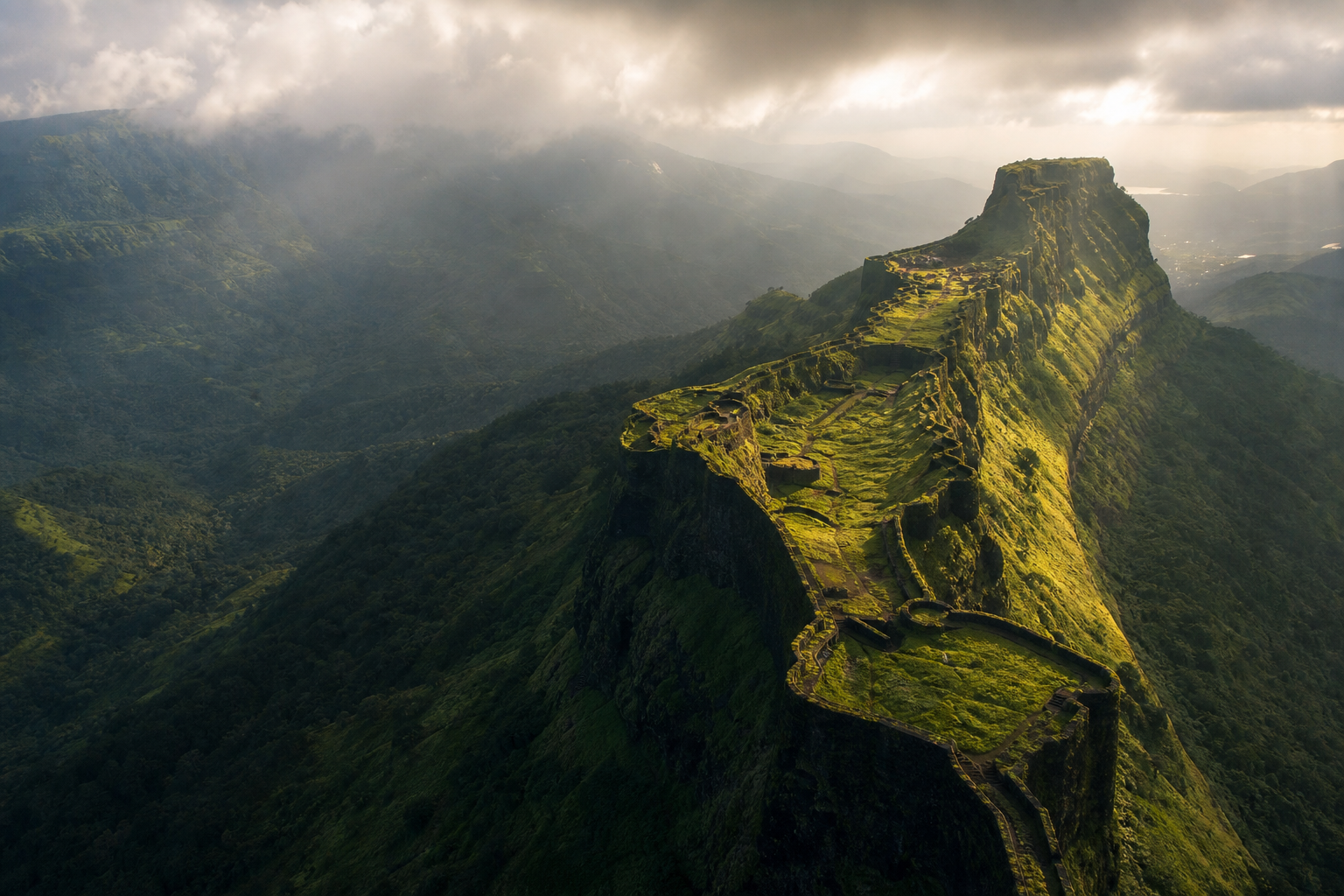
Rajgad was the first capital of the Maratha Empire. Shivaji Maharaj spent nearly 25 years of his life here, longer than on any other fort, shaping the destiny of Swarajya.
What is the history of Rajgad Fort?
Originally known as 'Murumbdev', Shivaji Maharaj captured it in 1645, fortified it extensively, and renamed it 'Rajgad' (The Royal Fort).
It served as the nerve center for numerous campaigns. The planning of Afzal Khan's defeat, the raid on Shaista Khan, and negotiations for the Treaty of Purandar occurred here.
Rajgad's architecture is unparalleled, featuring three vast extended machis (Padmavati, Sanjeevani, Suvela) and a towering central citadel (Balekilla).
What are the highlights of Rajgad Fort?
- Balekilla and its majestic Maha Darwaja
- Padmavati Machi, temple, and lake
- Sanjeevani Machi (Double-walled fortification)
- Suvela Machi and Nedhe (Natural rock hole)
Related to This Fort
Full History & Details
Rajgad (literal meaning ruling fort) is a Hill region fort situated in the Pune district of Maharashtra, India. Formerly known as Murumbdev, the fort was the first capital of the Maratha Empire under the rule of Chhatrapati Shivaji Maharaj for almost 26 years, after which the capital was moved to the Raigad Fort. Treasures discovered from an adjacent fort called Torna were used to completely build and fortify the Rajgad Fort.
The Rajgad Fort is located around 60 km (37 mi) to the south-west of Pune and about 15 km (9.3 mi) west of Nasrapur in the Sahyadris range. The fort lies 1,376 m (4,514 ft) above the sea level. The fort's base had a diameter of about 40 km (25 mi), making it difficult to lay siege to, thereby enhancing its strategic value. The fort's ruins consist of palaces, water cisterns, and caves. This fort was built on a hill called Murumbadevi Dongar (mountain of the goddess Murumba). Rajgad boasts of the highest number of days Shivaji spent on any fort. This Fort was inscribed in 2025 as a component site of the Maratha Military Landscapes of India, which were added to the UNESCO World Heritage List during the 47th session of the World Heritage Committee.
History
The fort has stood witness to many significant historic events including the birth of Shivaji's son Rajaram I, the death of Shivaji's wife Saibai, the return of Shivaji from Agra, the burial of Afzal Khan's head in the Mahadarwaja walls of Balle Killa, the strict words of Sonopant Dabir to Shivaji.
The Rajgad Fort was also one of the 12 forts that Chatrapati Shivaji Maharaj kept when he signed the Treaty of Purandar in 1665, with the Mughal general Jai Singh I, leader of the Mughal forces. Under this treaty, 23 forts were handed over to the Mughals.
List of chronological events
Tourism
The fort is a significant tourist destination, especially during the monsoon. Visitors prefer to stay overnight at the fort, as it is huge and cannot be explored in a single day. The Padmavati temple on the fort can accommodate around 50 people. Water tanks provide fresh water year-round. Villagers from the foothills of Rajgad sell local antiques and items to these tourists.
Gallery


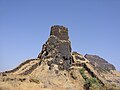

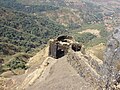
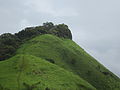

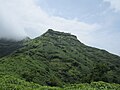
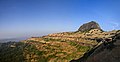


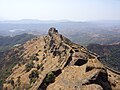

- Suvela machi
- Main door bastion
- Bastion
- steps
- Pali darwaza
- Duba
- Duba view
- Fort mountain
- Bale Killa of Rajgad
- Ballekilla, Rajgad
- Suvela Machi view from Rajgad balekilla Mahadwar
- Sanjeevani machi
- Nedha at Suvela machi
Compiled by: ShivJayanti Editorial Team · Cross-referenced with: Sabhasad Bakhar, Shivaji: His Life and Times
Source: Wikipedia (English) · मराठी · CC BY-SA